
I grew up with this note on our fridge at home: ‘man who says it cannot be done, must not interrupt woman who is already doing it!’. That’s my Dad’s handwriting. He laminated that note. He put it on the fridge.
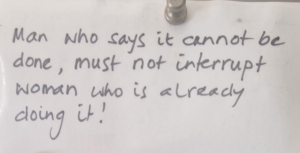
When I look at it I’m reminded of the very many women who are juggling an inconceivably unrealistic load and yet they’re just getting on with it, despite whomever is interrupting to tell them it’s impossible – to say the answer is ‘no’.
In our work at Fair4All Finance we see this a lot. Time and time again when we look at who most needs better access to financial products and services, it’s families struggling and very frequently it’s the women in those families who are working around the numerous ‘no’s’ they’ve had, and getting on.
No they can’t have a loan. No they can’t afford that kid’s birthday party, not this year, maybe next. No they can’t pay off their debts. No they can’t afford to save.
These are challenges they face because women are twice as likely as men to manage the day to day budgeting[i] – and for lots of women that makes for frenetic juggling of household finances – just about making ends meet, working multiple jobs, but then side swiped by an unexpected expense like the washing machine breaking down. The uphill climb to overcome these interruptions on a journey towards more financial resilience is no easy task and sometimes necessitates desperate measures. We see this in our data on the heightened share of people borrowing from unlicensed lenders and loan sharks who have dependents at home[ii]. And we see it in their limited credit choices with roughly 70% of higher cost and home collected credit going to women[iii].
Often these types of credit are their only option because of thin or suboptimal credit files. Many don’t know that they are entitled to their share of the £24billion in benefits that are unclaimed every year[iv], with even fewer knowing about credit union loans[v] that use child benefit as a way of increasing access to fair credit, indeed 28%[vi] of women use BNPL on a regular basis, some getting into trouble with late fees which is why we welcome the regulation of BNPL but we are also concerned about where people who’ve been relying on it will turn to next if they don’t meet new criteria[vii].
We worry about these choices, because credit is often essential for women when a bump in the road arrives because they’re less likely than men to have access to a savings buffer and are also more likely to have low or very low financial resilience[viii]. And sadly disabled women, women of colour, LGBTQT+ are more likely to be at the pointy end of these statistics.
Managing household budgets now also extends to juggling intra and inter family payments so no direct debt is missed overcoming inconsistent incomes on unpredictable dates[ix] – where the rigidity of the payment schedule is honored at the expense of someone’s sanity, a huge mental load. And women are also taking on supporting people get online – as some of the 11million people who help others with a digital transaction every year[x].
This sounds like next level juggling to me, but we also often hear in our work quite judgmental things said about people who lack savings, have too much debt or few choices for affordable credit. This seems deeply unfair given we know that half of people seeking debt advice have a deficit budget[xi] where they’re already managing money extremely carefully. Behavioural finance tells us that we’d be looking at a very empty room if we asked everyone who had ever made an ill-judged financial decision to leave. Nevertheless, that judgement is still perpetuated.
At a macro level it’s absurd. Michael Wolf’s piece in the Financial Times [xii]recently illustrated quite how dramatically well women are managing their finances. Managing them so well they are having impacts on population demography globally. Wolf points to Claudia Goldin’s work showing that women with graduate degrees are considerably less likely to have children because of the financial trade-offs it will entail; and to the dramatic collapse in fertility in rapidly economically growing countries, where gender norms put the costs of childcare at the woman’s door. He concludes by saying ‘gender norms will need to be even more equal and societal help with the costs of children even greater if there is to be much hope of raising fertility rates.’ What he’s really saying is women really need to be convinced they can get a fair deal.
Of course women are not some homogeneous group where everyone needs the same thing.
1.4million women experience financial abuse in the last five years[xiii]. It was fantastic to see the essential and urgent emphasis on improving the fairness of outcomes for victim survivors of economic abuse in the Financial Inclusion Strategy[xiv]. I am thrilled that Fair4All Finance will be launching a fund to bolster Credit Unions[xv], which already serve women who may otherwise be excluded from finance, as well as launching a Small Sum Lending pilot[xvi].
These programmes build on our ongoing affordable credit work, where last year 1/3 of affordable credit loans we backed went to lone parents with dependent children, very many of those are women. And we know credit is often not the right answer so we’re starting work this year to drive up take up of contents insurance, which can help women manage lumpy expenditure and crises.
On international women’s day it’d be fantastic to also say that we are aiming for fewer interruptions and more improvements that could help women create and seize opportunities for themselves:
- like the childcare loans Nest Insights has called for, helping to spread the gap of upfront costs of going back to work;
- like getting women connected to benefits they don’t know about;
- like maximising the number of women who are utilising the fantastically generous ‘Help to Save’ scheme given that they make up 66% of the eligible population[i],
- like improving the share of women who are listed as being due a spouses pension or life insurance policy;
- like increasing the share of women who have grown an emergency savings pot and a now also ready to invest.
Together all of these things and more will help us deliver £6.4bn in economic growth every single year. [xviii]
Author Bio: Kate Pender has been the Chief Executive at Fair4All Finance in September 2024. Prior to this Kate was Deputy CEO and Director of Growth and Development at Fair4All Finance and she led the development and delivery of £40m of scaled pilot testing of new propositions to support customers in vulnerable financial circumstances including the No Interest Loan Scheme, Consolidation lending pilots and implementation of benefits calculators and grant checkers in lending journeys, all of which JP Morgan have co-funded.
Since its inception in 2019, Kate has led Fair4All Finances’ work on growing the capability and resilience of community finance lenders including Fair4All Finance’s inaugural £12m investments into not for profit lenders, its technology investment fund, good practice guidance on mergers, diligence, compliant lending and most transformational leadership programme.
Prior to joining Fair4All Finance Kate had twenty years of experience in economic development and on support to accelerate the growth of small businesses.