
The Math Isn’t Mathing.
Women make up 50% of the world population and in some countries and regions they outnumber men. Despite this parity in numbers, when it comes to finances: The Math Isn’t Mathing.
We know global wealth inequality has ballooned over the last 30 years. Latest numbers show that 38% of global wealth gains were captured by the top 1%, while the bottom 50% got just 2%. In the UK, the top 10% now hold 57% of all wealth, up from around half in 1990.
But we also know (or should know) that wealth inequality is gendered.
Men hold considerably more wealth than women.
In the UK alone, the gender wealth gap for women ranges from 21% to 35%, some £78,000 to £90,000 less per person.
Over the years, significant focus and efforts have been on eradicating the gender pay gap – and for good reason. The Employment Rights Act 2025 mandates compulsory gender pay gap reporting from 2027. Yes, you read that right. 2027! So even that gain has been long and hard fought.
But a focus on income alone, means we miss the bigger picture. Analysis by the Women’s Budget Group shows that wealth inequality is higher than income inequality. The highest 10% of earners receive 36% of total income. Whilst the wealthiest 10% own 57% of total wealth.
The gender wealth gap – even at the lower-end of the range at 21% – is nearly double the gender pay gap of 13%. Meanwhile, the gender pension gap is even higher at 43%, with men holding nearly £67,000 more than women. Which means the wealth gap widens with age.
Black and Minoritised women face even wider wealth gaps as our recent research Systemic Barriers to Financial Inclusion highlighted:
Crenshaw’s articulation of intersectionality (1991) shows how Black and minoritised women, especially those balancing caregiving duties and low-income work, face compounded barriers in accessing financial products. Despite having similar credit profiles to other groups, these women are disproportionately denied mortgages, business loans, and other wealth-building tools. This systemic oversight is not merely an error in underwriting; it is an institutional manifestation of intersecting oppressions rooted in racial and gendered assumptions about risk, capability, and economic value.
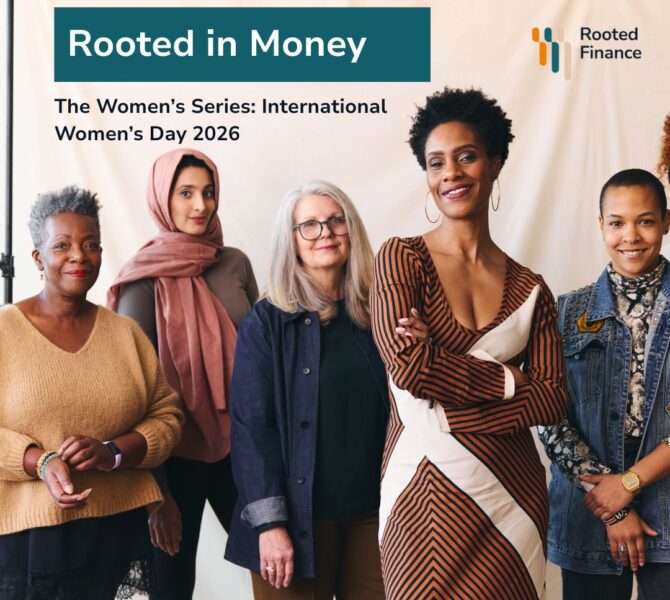
International Women’s Day 2026
The theme for this year’s International Women’s Day #IWD is ‘Give to Gain’, forging gender equality through abundant giving.
However, gender equality cannot be achieved, without calling out an economic and financial system which routinely takes from women, but ensures they gain less. Continuing to prop-up an extractive and structurally biased system, that compounds the gender wealth gap and has built-in intersectional bias – isn’t the liberation some might have us believe.
The theme Give to Gain also encourages a mindset of generosity and collaboration – and it is in this sprit that we share with you Rooted in Money – The Women’s Series.
We are thrilled to have a stellar line-up of women working across financial services and civil society contribute thought-provoking, provocative and insightful pieces:
- Kate Pender, CEO at Fair4All Finance, explores the High-Cost Credit Cycle and Women
- Sam Smethers, CEO, Surviving Economic Abuse, examines the Shadow of Debt: Confronting Coerced Debt and Economic Abuse
- Vivienne Hayes, CEO, Women’s Resource Centre, explains how the women’s sector is Underfunded and Overburdened – The Impact of Gendered Public Funding
- Timi Okuwa, CEO, Black Equity Organisation, outlines the need for culturally relevant and strength based Financial Literacy for Young Black Women
- Jo Phillips, Director of Research and Innovation, Nest Insight, makes the case for Bridging the Pensions and Wealth Gap.
This series will interrogate the inequalities inherent in our financial systems from a gendered perspective and drill down on the component issues that contribute and compound the gender wealth gap.
Rooted In Money is a bold, provocative and solutions focused series with clear calls to action. This Women’s Series isn’t any different, so get involved and embody the #GiveToGain spirit by thinking about how you can contribute and add to the efforts outlined in each piece.
All the contributors are phenomenal women making a difference to the daily lives of women and girls – they live and breathe generosity and collaboration in the work they lead and champion.
So, I’d like to take this opportunity to thank Kate, Sam, Viv, Timi and Jo for their honest and frank contributions.
I’m lucky to have them in my circle, and it would be ungenerous of me not to share their sage insights more widely. Happy IWD!
Introduction blog: Muna Yassin MBE, CEO, Rooted Finance.